,Poland, before it was established as a country and as a nation, was the home land – for somehundred years- of the Vandals. The vandals was a great nation in the “Migration Period” in Europe. In some historical debates it is claimed that Poles a descendants of Vandals. It is also claimed that the first and legendary father of Poles was Wandal or Wandalin.
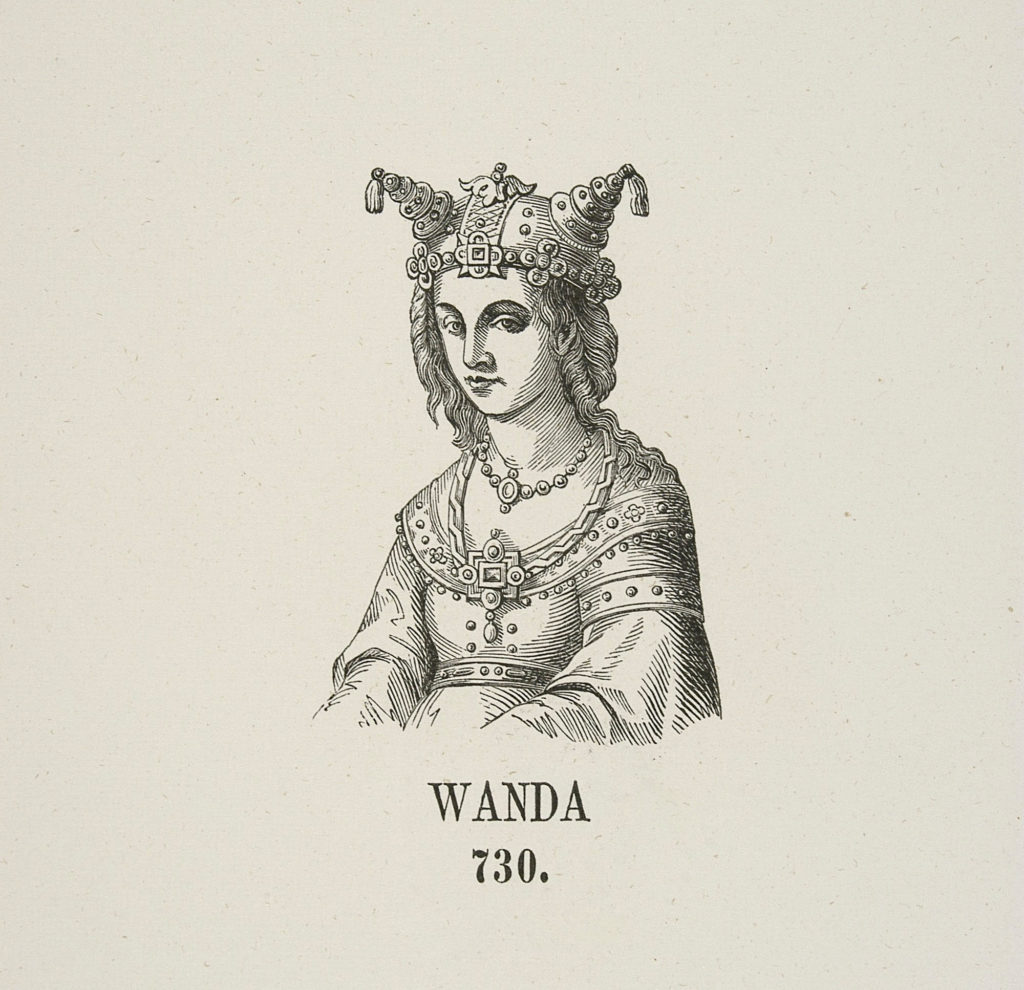
Poles were called vandals. The great legendary princess of Poland, Wanda said to be the queen of Vandals (Poles) . In Polish Chronicles by Wincenty Kadłubek it is written ((The Wandalus (Vistula) river name came from her name, because it was the center of the kingdom; hence, all who were under her authority, were called Vandals”. Gervase of Tilbury wrote in his” Otia Imperialia” that The Poles “are referred to as the Vandals and so they call themselves”
Regardless of the debate on the origins of the vandals and their connection with ancient Poles, no doubt that they were part of the history of Poland and Central Europe and its culture (mainly the Przeworsk culture). Many polish villages are called now Wandalin, may be in remembrance of its vandal history.
The vandals however left Poland and immigrated to the west, engaging in different wars, alliances and building different states. They established a new state of Vandalia in south of Spain (today Andalusia) , but their great glory was in Africa. The Vandals has entered North Africa in 429 and in 435 they established a kingdom which included the areas of today Tunis, East Algeria, Mauritania, as well as the islands of Sicily, Corsica, Sardinia, Malta and the Balearic Islands. The powerful kingdom of “Vandals, Allans and Berbers” fended off several Roman attempts to recapture North Africa from them, and sacked the city of Rome in 455.
The African kingdom of the Vandals collapsed in 534 and the vandal nation disintegrated. Many Vandals went to Béjaïa in north Algeria and integrated with the Berbers. Many others were put into military services of Rome and Byzantium or fled to the Gothic kingdoms in South of Europe. The vandals as a great nation has disappeared from the scene of history.
The modern word “vandalism “is coined from a false reputation of the Vandals as barbarian people who devastated Europe and Rome in their wars. The Vandals were definitely not more barbarian or destructive than any other nation or invaders of their times, including Romans. It is Rome-centrism which blamed them for its destruction and portrayed them as barbarians. On the contrary, Vandals seems to be more civilized nation and kingdoms than others, taking into consideration the conditions of their times.
The Vandals were easily integrating with other nations. In Europe they build an alliance with the Allans, an Iranian immigrating nation, and together they built their kingdoms in South Spain and North Africa. Historian Averil Cameron suggests that the new Vandal State in North Africa have been welcomed warmly by the native population of North Africa, suffering under the repression of Rome, and a Vandals-Berber alliance was build. The vandals, being Arians themselves, has guaranteed freedom of religion in their kingdom for Catholics and others, regardless of the religious fanaticism of their time.
The Vandals were not destructible at all while entering into Africa. Recent archaeological researches show that street pattern remained the same and some public buildings were renovated and new industrial centers were built within towns during their domination. Historian Andy Merrill proofed that the rule of Vandals in North Africa was a time of economic stability and prosperity.
We can surely tell today that descendants of Vandals remained and integrated within the people of Poland and Africa, since nations do not vanish totally, but like snow in spring they turned into water and goes deep in the earth. The recent archeological surveys shows that the great vandals were connected mainly with Poland and Africa. There are different evidences that the Vandals in Africa kept contact with their people and allies in Poland . This is another linkage between the two cultures, and a another reason why we tell that Poland is Black 🙂 .
Adil Abdel Aati
21/11/2016
References:
• Jerzy Strzelczyk: Wandalowie i ich afrykańskie państwo. Państwowy Instytut Wydawniczy, 2005.
• Vandals, Wikipedia: https://en.wikipedia.org/wiki/Vanda…
• Polacy a Wandalowie : Wikipedia : https://pl.wikipedia.org/wiki/Polac…
• Merrills, Andrew H. [Publ.]. Collection of Essays, Vandals, Romans and Berbers. New Perspectives on Late Antique North Africa · – Cambridge (2004)
• Cameron, Averil (2000), “The Vandal conquest and Vandal rule (A.D. 429–534)”, The Cambridge Ancient History. Late Antiquity: Empire and Successors, A.D. 425–600, XIV, Cambridge University Press, pp. 553–559
• Collins, Roger (2000), “Vandal Africa, 429–533”, the Cambridge Ancient History. Late Antiquity: Empire and Successors, A.D. 425–600, XIV, Cambridge University Press, pp. 124–126
• Nasi bracia Wandalowie: Newsweekpolska: http://www.newsweek.pl/nauka/nasi-b…